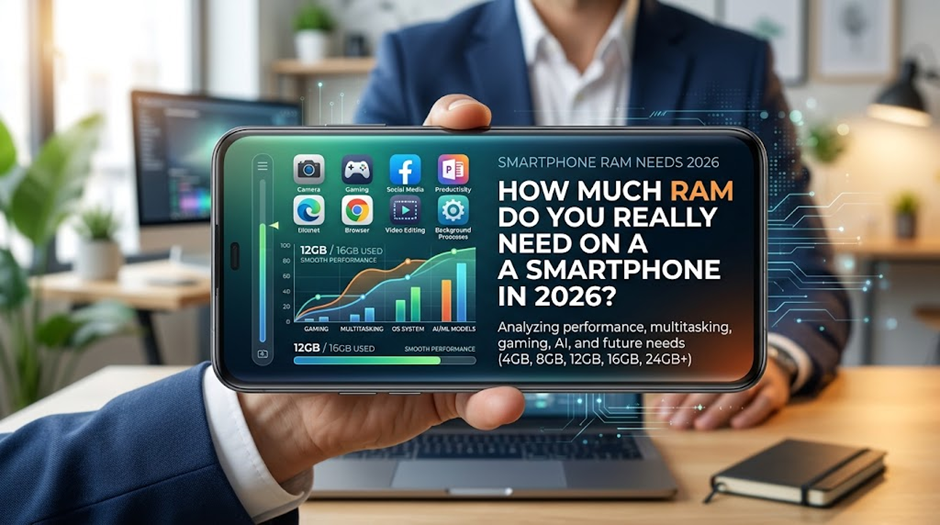
RAM is very central to a smartphone. It enables your phone to run applications and cope with numerous activities simultaneously. However, having significantly more RAM itself does not always translate into much improved performance. Many phones these days have either 8GB, 12GB – or occasionally even 16GB RAM. This really complicates the process of selecting a phone. Many users might not actually need the very highest RAM option though.
What the right amount is really depends on just how you use your phone.Casual users will probably require something other than serious gamers or individuals who perform very demanding multi-tasking activities themselves.
What does RAM do in a smartphone?
RAM stands for Random Access Memory. It’s essentially temporary storage space that your phone uses all the time while it’s running. Whenever you launch an app, a bit of its information takes up RAM. Then, when jumping frequently between applications, RAM really helps bring them back online in the background – so they’re much quicker to find next time too.
Getting a little extra RAM might let your phone keep several more applications open at once, making transitioning between them truly very smooth indeed. Nevertheless, RAM is just one component that makes up a smartphone’s entire performance profile. Your processor, operating system, internal storage space, and cooling system all contribute significantly as well. A phone with 12GB RAM isn’t always going to outperform all others with 8GB RAM – definitely not.
How Much RAM Do You Really Need?
Just how much RAM you need is based on your regular day-to-day activities quite a lot. For fairly light tasks, 4GB or 6GB might still suffice, especially if you’ve got a decent phone model. Though 6GB isn’t quite as appealing anymore to those looking for a future-proofed device.
For most people purchasing a new phone in 2026, 8GB RAM will probably be just right for starters. The heavy multitasker or avid gamer may prefer having 12GB, or even slightly more. Here’s a rough guide to follow:
| RAM | Best For | Overall Use |
| 4GB | Basic tasks | Light |
| 6GB | Calls, browsing, social apps | Moderate |
| 8GB | Daily use and multitasking | Very Good |
| 12GB | Gaming and heavy multitasking | Excellent |
| 16GB+ | Heavy gaming and advanced use | Enthusiast |
These are pretty loose guidelines. Your phone’s actual performance really relies on both the processor and the software itself, don’t forget that!

Is 8GB RAM Enough by 2026?
For the average smartphone user, 8GB RAM is quite sufficient indeed. It’ll easily handle daily stuff like web browsing, texting, checking social media, watching videos online, and taking standard photos every day. Also, an 8GB phone should offer pretty seamless multitasking capabilities if paired with a strong processor and finely-tuned software too.
Don’t pick out a phone primarily because another model has a lot more RAM, okay? Instead, really take a look at the full specs sheet. A nice balance between RAM, processor speed, storage capacity, and operating system generally yields way better results overall. To many potential buyers, spending that little bit extra cash on a faster processor or much bigger storage space would make way more sense rather than just focusing on getting more RAM itself.
When Should You Opt for 12GB RAM?
12GB RAM really counts for very demanding users. You might actually profit from 12GB if you constantly flip through lots of different programs. It’ll also be quite helpful for extremely challenging games and all sorts of heavy applications. Think about getting 12GB RAM if you:
- Play highly demanding mobile games all the time.
- Constantly edit photographs or video clips.
- Have a bunch of programs running simultaneously all the time.
- Utilize your phone extensively for professional purposes.
- Run rather demanding productivity tools continuously.
- Need even more space for any potential future program requirements.
- However, 12GB isn’t absolutely necessary for everyone by far.
If you mainly use WhatsApp, YouTube, web surfing, social networking sites, and just basic camera capabilities, 8GB will generally suffice enough.
Will More RAM Really Speed Up Your Phone?
Having a bit more RAM will indeed enhance your ability to juggle lots of tasks, yet it won’t directly accelerate your phone’s speed by that much itself. Your processor does most of the hard work when it comes to actual processing. Even storage speed and software fine-tuning greatly affect just how fast apps launch and respond themselves.
Consider this: a phone equipped with 8GB RAM and a seriously powerful processor might outperform another phone with 12GB RAM, especially if that second phone has poorly written software. That’s why shoppers need to really examine the whole specs list thoroughly. You really ought to consider benchmark scores too and actual everyday reviews as well when comparing handsets. RAM really should be seen as just one component within your total performance bundle deal.
Just what amount of RAM is Ideal for Playing Games?
Gaming on your mobile device requires quite a lot of system resources. Games with very detailed visuals and huge play areas often see an advantage with added RAM. And even more RAM helps loads when switching between playing games and doing something else too. For light gaming purposes, 8GB RAM is usually quite acceptable.
For very serious gaming, though, 12GB RAM gives you just that bit more space to breathe. Gamers eyeing the best-of-breed devices may want to consider getting 16GB models instead. Still, RAM by itself doesn’t define gaming quality at all. Your processor, graphics system, cooling, screen refresh rate, and battery life are all pretty equivalent factors too.

Ought You Get a Phone with 16GB RAM Instead?
To the majority of us, 16GB RAM is essentially unnecessary. It really makes sense for hardcore fans who truly desire the best hardware possible, or folks who do some really difficult jobs very regularly. Flagship models occasionally come with super-high RAM options because they have some unique premium features.
However, if your usual tasks aren’t very demanding, shelling out loads more cash for 16GB won’t really make a noticeable difference in performance anyway. You may do better spending that extra money on more internal storage space, better cameras, a significantly longer battery life – or indeed a still more powerful processor.
RAM vs Storage, what’s the difference?
RAM and storage serve very distinct purposes. RAM temporarily stores information used by currently open applications. Storage really holds onto your pictures, videos, apps, and files – even when you’ve shut down the actual phone itself. Here’s an example: a phone with 8GB RAM and 256GB storage space will have:
8GB of RAM to run things very efficiently indeed. 256GB of storage space to store all your files and apps permanently. Don’t ever mistake these specs when evaluating phones. If you constantly capture many photographs or record loads of video clips, more storage might matter a lot more than extra RAM itself.
What should you go for in 2026?
To many buyers, 8GB RAM offers a pretty good balance between budget and performance. If you often work with lots of applications at once, play games very seriously, or need just a little more processing power when required, then opt for 12GB instead. Choose 16GB if you’re pushing your device to the max – and the additional cost isn’t too outrageous.
Think twice before buying, look over all the specifications carefully rather than concentrating entirely on the RAM amount itself. PhonePrice will assist shoppers in comparing smartphones’ specs, their respective costs, and key characteristics so they can select their next gadget wisely.
Conclusion
You don’t always require the maximum amount of RAM possible. The correct amount really depends upon how you make use of your smartphone every day. Basic users might get by just fine with 6GB RAM, especially on suitable handsets. Most new smartphone purchasers in 2026 would probably find 8GB gives them plenty of oomph. Hardcore players and heavy users might prefer 12GB RAM instead. Power users could think about 16GB or even more.
Above all else, do not determine a phone based solely on its RAM specification. Take into account its processor speed, memory capacity, software, battery life, screen quality, and total value proposition too. Picking out a well-rounded smartphone will provide you with far better performance, without spending money on excessive hardware that you might rarely, if ever, really utilize.