When comparing smartphones, processor specifications such as CPU cores, clock speed, and chipset name don’t always tell the full story. That’s why many buyers look at AnTuTu and Geekbench scores to understand how a phone performs.
But AnTuTu and Geekbench measure performance differently. A phone can have a strong Geekbench score without having the highest AnTuTu score, and vice versa.
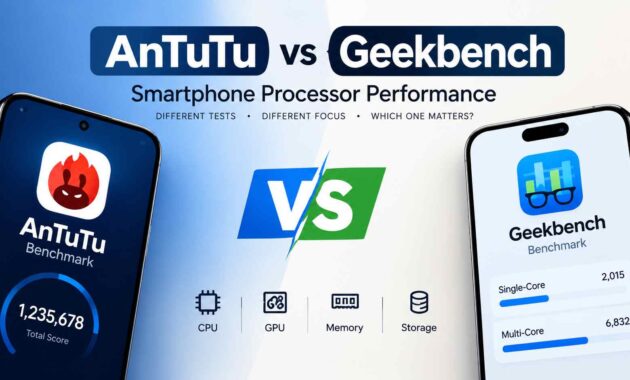
So, what is the difference between AnTuTu vs Geekbench, and which benchmark should you use when comparing smartphone processors?
Let’s break it down.
What Is AnTuTu Benchmark?
AnTuTu is a popular smartphone benchmarking platform designed to provide a broader measurement of device performance.
Rather than focusing primarily on CPU performance, AnTuTu evaluates several components of a smartphone.
Depending on the version and platform, its testing can include:
- CPU performance
- GPU performance
- Memory performance
- User experience and system performance
- Storage and related workloads
The result is generally presented as an overall score, making it useful for getting a quick idea of a phone’s total benchmark performance.
For example, two smartphones may have different processors but similar overall AnTuTu scores. This can suggest that their combined CPU, GPU, memory, and system performance is relatively close under the benchmark’s workload.
What Is Geekbench?
Geekbench is primarily designed to measure processor performance through standardized workloads.
One of its most commonly discussed results is the:
- Single-core score
- Multi-core score
The single-core result provides an indication of performance when workloads rely heavily on one CPU core.
The multi-core result measures performance when multiple CPU cores are working together.
Geekbench can therefore be particularly useful when you want to focus specifically on CPU performance rather than the entire smartphone system.
Also Read:Does a Faster Smartphone Processor Improve Battery Life?
AnTuTu vs Geekbench: Key Difference
The simplest way to understand the difference is:
AnTuTu = broader device performance
Geekbench = primarily CPU performance
AnTuTu combines multiple areas of smartphone performance into an overall score, while Geekbench provides more focused CPU results.
Here’s a quick comparison:
| Feature | AnTuTu | Geekbench |
|---|---|---|
| CPU testing | Yes | Yes |
| GPU testing | Yes | Yes, depending on test/platform |
| Memory testing | Yes | More limited/focused |
| Overall device score | Yes | No single overall phone score in the same sense |
| Single-core CPU score | Not its main focus | Yes |
| Multi-core CPU score | Not its main focus | Yes |
| Best for | Overall device comparison | CPU comparison |
Which Benchmark Is Better for Comparing Smartphone Processors?
There isn’t one benchmark that is universally better.
It depends on what you want to measure.
If you want to compare the overall performance of two smartphones, AnTuTu can provide a broader picture.
If you’re specifically interested in processor performance, Geekbench’s single-core and multi-core results can be more useful.
For a more complete comparison, looking at both benchmarks can provide additional context.
Understanding Geekbench Single-Core Performance
Geekbench’s single-core score is useful for understanding how well a processor performs when a workload primarily uses one CPU core.
Single-core performance can influence everyday activities such as:
- Opening applications
- General interface responsiveness
- Web browsing
- Some productivity tasks
- Certain lightly threaded workloads
A processor with strong single-core performance can feel responsive during many everyday operations.
However, a benchmark score should not be treated as a direct measurement of how fast every app will open. Real-world performance also depends on software optimization, storage, RAM, thermal behavior, and other components.
Understanding Geekbench Multi-Core Performance
Multi-core performance measures how effectively a processor handles workloads that can use several CPU cores simultaneously.
This can be useful for tasks such as:
- Video processing
- Heavy multitasking
- File compression
- Content creation
- Certain computational workloads
A higher multi-core score generally indicates stronger performance in workloads that can effectively use multiple cores.
However, not every smartphone application benefits equally from additional CPU cores.
What Does an AnTuTu Score Tell You?
AnTuTu’s overall score is intended to represent performance across multiple areas of a smartphone.
That’s useful because smartphone performance isn’t determined by the CPU alone.
For example, a phone might have:
- A powerful CPU
- A powerful GPU
- Fast memory
- Fast storage
- Optimized system software
AnTuTu attempts to reflect the combined performance of several of these areas.
This makes its overall score useful for quick smartphone-to-smartphone comparisons.
Why AnTuTu Scores Can Be Higher on Gaming Phones
Gaming-focused smartphones often have powerful GPUs, advanced cooling systems, high-performance processors, and aggressive performance modes.
Because AnTuTu evaluates more than CPU performance, improvements in GPU and other components can have a noticeable effect on the overall score.
This is important when comparing AnTuTu results.
A higher overall score doesn’t necessarily mean the phone has a dramatically faster CPU. The difference could come partly from GPU, memory, or other system performance.
Why Geekbench Scores Can Be Useful for Processor Comparisons
If you’re comparing two smartphone chipsets and mainly want to understand their CPU capabilities, Geekbench makes it easier to separate:
Single-core performance
from
Multi-core performance
This can be more informative than looking at one combined score.
For example, a processor could have excellent single-core performance but a smaller multi-core advantage. Another processor might perform particularly well when multiple cores are heavily utilized.
Looking at both numbers provides more information than simply asking which phone has the higher overall benchmark score.
Does a Higher Benchmark Score Mean a Faster Smartphone?
Not always.
Benchmarks are controlled tests. Real-world smartphone performance depends on many additional factors.
These include:
- Software optimization
- RAM capacity
- Storage speed
- Thermal management
- Background applications
- Operating system version
- App optimization
- Display resolution and refresh rate
- Battery and power-management settings
A smartphone with a slightly lower benchmark score can sometimes feel just as fast—or faster—in everyday use.
Benchmark Scores and Thermal Throttling
One important factor to consider is thermal throttling.
When a smartphone processor becomes hot during demanding workloads, the device may reduce processor performance to control temperature and power consumption.
This means a phone can achieve a very high benchmark score during a short test but perform differently during a long gaming session.
For this reason, sustained performance tests can be useful when evaluating gaming or heavy workloads.
Should You Trust Smartphone Benchmark Scores?
Benchmark scores are useful, but they shouldn’t be the only factor in a smartphone buying decision.
A better approach is to combine benchmark results with:
- Real-world performance tests
- Gaming performance
- Sustained performance
- Battery life
- Thermal behavior
- Software experience
- Camera processing performance
- Storage performance
Benchmarks are best viewed as one measurement tool, not a complete definition of smartphone performance.
AnTuTu vs Geekbench for Gaming
If your main concern is gaming performance, AnTuTu can provide useful information because it considers GPU and other system components in its broader testing.
However, benchmark scores alone don’t tell you exactly how a particular game will perform.
For gaming, also check:
- Average FPS
- 1% lows or frame-time consistency
- Sustained performance
- Temperature
- Power consumption
- Graphics settings
- Game optimization
A smartphone with a slightly lower benchmark score can deliver a better gaming experience if it maintains stable performance for longer.
AnTuTu vs Geekbench for Everyday Use
For everyday tasks such as messaging, browsing, social media, and streaming, extremely high benchmark scores may not produce a noticeable difference.
Once a smartphone has enough processing power for your daily applications, other factors can become more important.
These include:
- Software smoothness
- Display quality
- Battery life
- App optimization
- Storage speed
- Network performance
This is why buying a phone based solely on the highest benchmark score isn’t always the best approach.
How to Compare Two Smartphone Processors
When comparing processors, consider the following approach:
Step 1: Check Geekbench Single-Core
This gives you an indication of CPU performance in lightly threaded workloads.
Step 2: Check Geekbench Multi-Core
This helps compare performance in workloads that can use multiple CPU cores.
Step 3: Compare AnTuTu Scores
Use AnTuTu to get a broader view of overall device performance.
Step 4: Check GPU Performance
Gaming and graphics-heavy applications depend heavily on GPU performance.
Step 5: Look at Sustained Performance
Check whether the phone maintains performance during extended workloads.
Step 6: Consider Power Efficiency
A processor that delivers strong performance while using less power can provide a better overall smartphone experience.
AnTuTu vs Geekbench: Which One Should You Use?
The answer depends on what you’re trying to compare.
Choose Geekbench when:
- You want to compare CPU performance.
- You want single-core results.
- You want multi-core results.
- You’re comparing smartphone processors specifically.
Choose AnTuTu when:
- You want a broader device performance comparison.
- GPU performance matters.
- Memory performance matters.
- You want an overall benchmark score.
Use both when:
- You’re comparing flagship processors.
- You’re choosing a gaming smartphone.
- You’re researching a new phone before buying.
- You want a broader understanding of performance.
Final Verdict
AnTuTu and Geekbench measure different aspects of smartphone performance, so neither should be considered universally better.
Geekbench is particularly useful for examining CPU single-core and multi-core performance, while AnTuTu provides a broader picture by combining several areas of device performance into an overall score.
If you’re comparing smartphone processors, the best approach is to look at Geekbench CPU results, AnTuTu results, sustained performance, power efficiency, and real-world testing together.
Ultimately, the highest benchmark score doesn’t automatically mean the best smartphone for every user. Your choice should depend on how you plan to use the device and which performance characteristics matter most to you.
Frequently Asked Questions
Is AnTuTu better than Geekbench?
Neither benchmark is universally better. AnTuTu provides a broader device performance measurement, while Geekbench is particularly useful for CPU performance comparisons.
Is Geekbench more accurate than AnTuTu?
They measure different things, so accuracy depends on what you’re trying to measure. Geekbench is useful for CPU-focused testing, while AnTuTu evaluates a broader range of device components.
What is more important, AnTuTu or Geekbench?
For processor comparisons, Geekbench’s single-core and multi-core scores can be useful. For overall smartphone performance, AnTuTu provides a broader measurement.
Does a higher Geekbench score mean a better processor?
A higher score generally indicates stronger performance in the benchmark’s tested workloads, but it doesn’t guarantee better performance in every real-world application.
Should I compare AnTuTu scores before buying a phone?
AnTuTu scores can be useful when comparing phones, but consider them alongside battery life, thermal performance, software optimization, camera performance, display quality, and real-world reviews.